
Join us, along with our partners at The Starbucks Foundation, to write letters of gratitude and show our COVID-19 Frontline Responders that as long as they continue to serve, we will continue to support them. This is our opportunity for action!
Sunday, July 26, 2020
Saturday, July 18, 2020
Winchester Farmers Market July 18th, 2020
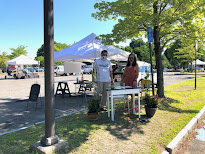
Thanks to Fred Y for allocating space for us to be at the market, Fran S for lending us the tent, and Linda F and Karen F, we spread the word about writing letters, and distributed 30 packets of stationery, stamped envelopes, information sheets with ideas for starting a letter, and most had pens.
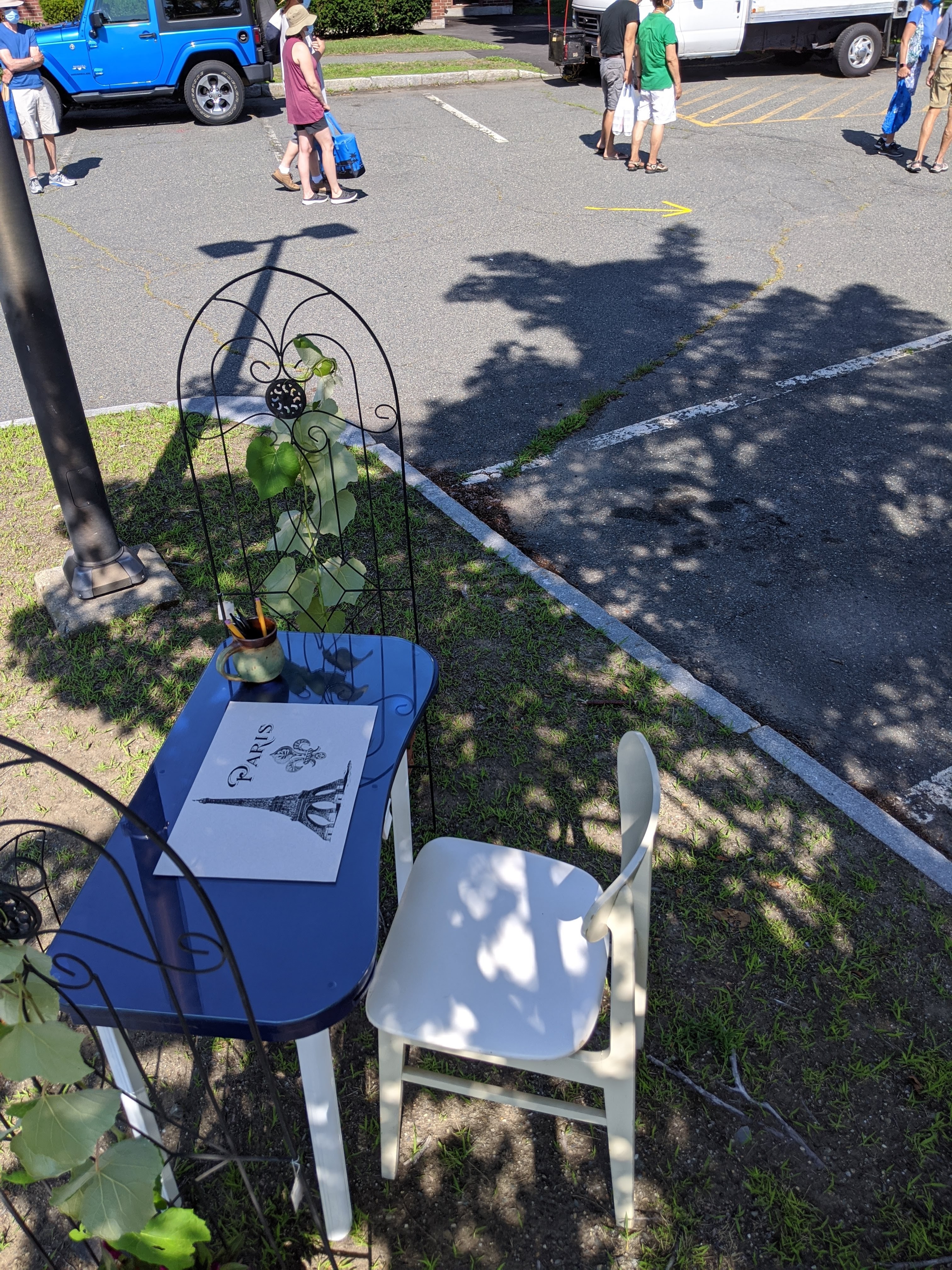
After Covid we could have people sit down in the cozy writing desk and write a letter right at the market (with appropriate distancing and wipe downs in between).






Tuesday, July 14, 2020
Letters Trellis at the Winchester Farmers Market July 18, 2020.
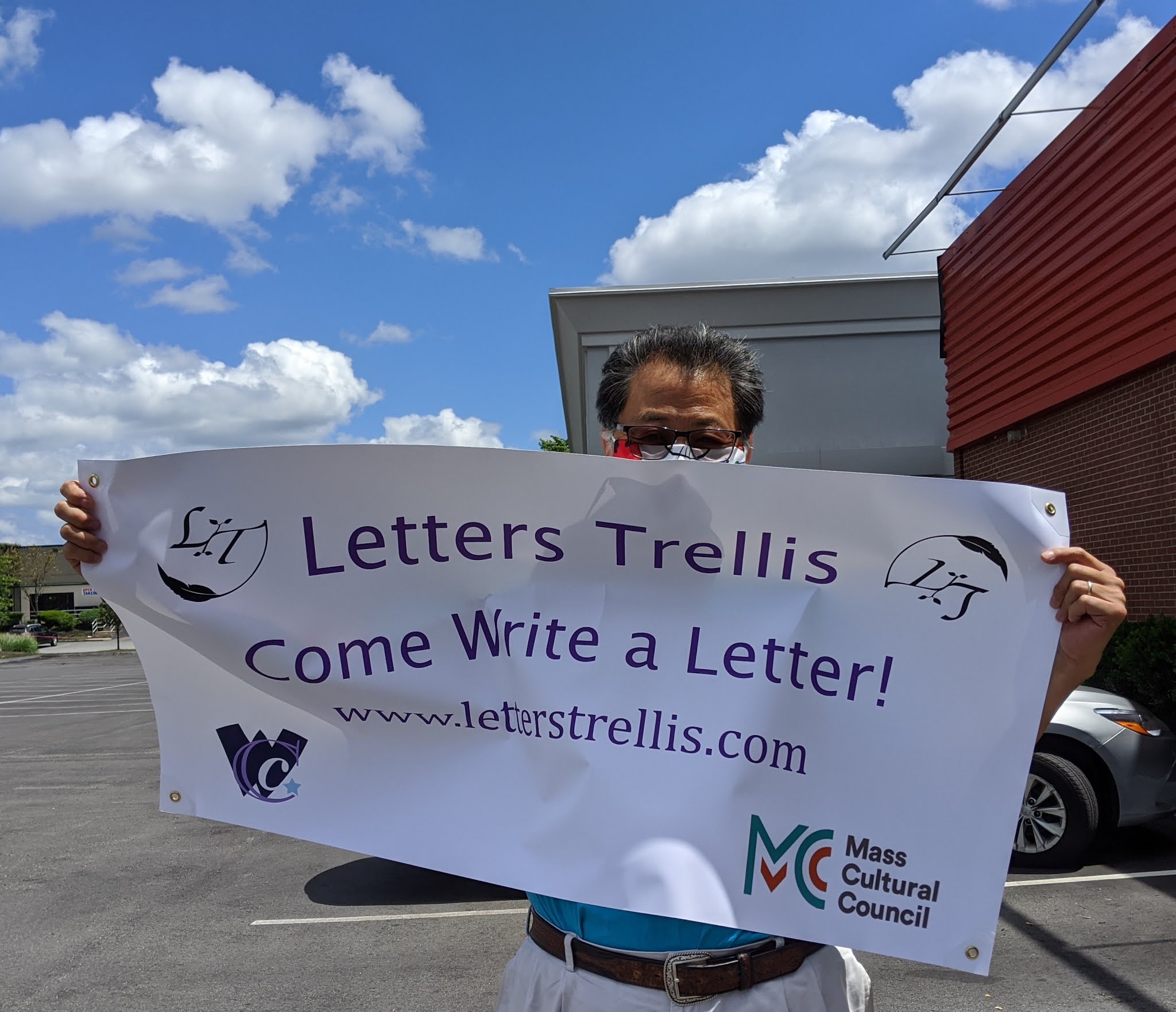
Letters Trellis (www.LettersTrellis.com) is coming to the market on July 18th. This is an effort to encourage hand-written letters in an era when these little packages of thoughts and feelings can be a welcome diversion from electronic mail and post boxes stuffed with flyers and bills. “ Post it Forward ”, the first Letters Trellis community venture, responds to the need to re-connect in a personal way when we can’t be physically close to others. Sponsored by the Winchester and MA Cultural Councils, this special offering of letter-writing packets will be available for pre-order. Numbers are limited; to avoid disappointment reserve yours online at https://forms.gle/pHmvLvcdt1tVm7XR9 and pick it up at the Letters Trellis table.
Wednesday, June 24, 2020
Snail Mail Is Getting People Through This Time
https://www.nytimes.com/2020/06/24/style/mail-letters-coronavirus.html
Snail Mail Is Getting People Through This Time
Letter writing has helped people meaningfully connect during this period of isolation, grief and unrest.
 Laura Stanfill sent this watercolor-and-collage art piece to her friend Kathlene Postma, who gardens.Credit...Laura Stanfill
By Tove Danovich
June 24, 2020
Brianca Hadnot’s high school students in Houston started writing letters the day after George Floyd was killed.
“They felt unheard,” Ms. Hadnot, 30, said. “They can’t vote.”
As protests gained momentum around the country, she worried about them attending and possibly being tear gassed or shot with rubber bullets. Writing, she said, was another way the students could take action against police brutality.
“A letter is one of the most undervalued but important ways of expressing yourself,” said Ms. Hadnot, who teaches sophomore literature and writes under the name Brianca Jay. “It doesn’t have to be perfect or written with the best grammar and semantics and flowery prose. It just has to be you.”
The students, with help from other community members, have written 75 letters so far, addressed to elected officials including local legislators and the president of the United States.
Snail mail has taken on fresh resonance in this period of isolation, grief and unrest. Sympathy cards are selling out as the coronavirus’s toll continues to rise. Constituents are mailing in primary election ballots and addressing handwritten notes to local officials with compliments and complaints. (In some cities, they may also be sending letters to the police.) Many more are writing postcards to friends and loved ones, and calling for the United States Postal Service to be saved from its dire financial straits.
First-class mail has been a declining category for the Postal Service for over a decade. It will be a few months before the service publishes statistics on mail volumes for April and May, but it did see “significantly higher product sales” of items including stamps in April, according to a representative. A Postal Service survey whose results were published in May found that one in six consumers had sent more mail to family and friends during the pandemic.
Kenzie Myer, 21, said that she wasn’t a letter writer before the pandemic, which forced her to leave a study-abroad program in London and return to her home in Pennsylvania.
“I came back and hadn’t seen any of my friends from my home school,” Ms. Myer, a rising senior at Arcadia University, said. “I started sending them letters.” Most of them open with a disparaging line about her “garbage handwriting,” she said, then become more personalized.
For a friend whose 21st birthday passed in lockdown, she wrote about how she couldn’t wait to celebrate in person. For her partner, who lives in Australia, she writes “a lot of sappy stuff” and smears the page with roller-ball perfume. She posts her correspondents’ responses on her bedroom wall near her desk.
“Even though I can’t see the people that I love, they’re sending love back my way,” Ms. Myer said.

Snail Mail Is Getting People Through This Time
Letter writing has helped people meaningfully connect during this period of isolation, grief and unrest.
Laura Stanfill sent this watercolor-and-collage art piece to her friend Kathlene Postma, who gardens.Credit...Laura StanfillBy Tove Danovich
June 24, 2020
Brianca Hadnot’s high school students in Houston started writing letters the day after George Floyd was killed.
“They felt unheard,” Ms. Hadnot, 30, said. “They can’t vote.”
As protests gained momentum around the country, she worried about them attending and possibly being tear gassed or shot with rubber bullets. Writing, she said, was another way the students could take action against police brutality.
“A letter is one of the most undervalued but important ways of expressing yourself,” said Ms. Hadnot, who teaches sophomore literature and writes under the name Brianca Jay. “It doesn’t have to be perfect or written with the best grammar and semantics and flowery prose. It just has to be you.”
The students, with help from other community members, have written 75 letters so far, addressed to elected officials including local legislators and the president of the United States.
Snail mail has taken on fresh resonance in this period of isolation, grief and unrest. Sympathy cards are selling out as the coronavirus’s toll continues to rise. Constituents are mailing in primary election ballots and addressing handwritten notes to local officials with compliments and complaints. (In some cities, they may also be sending letters to the police.) Many more are writing postcards to friends and loved ones, and calling for the United States Postal Service to be saved from its dire financial straits.
First-class mail has been a declining category for the Postal Service for over a decade. It will be a few months before the service publishes statistics on mail volumes for April and May, but it did see “significantly higher product sales” of items including stamps in April, according to a representative. A Postal Service survey whose results were published in May found that one in six consumers had sent more mail to family and friends during the pandemic.
Kenzie Myer, 21, said that she wasn’t a letter writer before the pandemic, which forced her to leave a study-abroad program in London and return to her home in Pennsylvania.
“I came back and hadn’t seen any of my friends from my home school,” Ms. Myer, a rising senior at Arcadia University, said. “I started sending them letters.” Most of them open with a disparaging line about her “garbage handwriting,” she said, then become more personalized.
For a friend whose 21st birthday passed in lockdown, she wrote about how she couldn’t wait to celebrate in person. For her partner, who lives in Australia, she writes “a lot of sappy stuff” and smears the page with roller-ball perfume. She posts her correspondents’ responses on her bedroom wall near her desk.
“Even though I can’t see the people that I love, they’re sending love back my way,” Ms. Myer said.
Henry, 4, punches out letters to friends and family on a typewriter he received for Christmas.
Justin Hodges, 46, moved to Chicago three years ago and soon received a postcard from a local candidate. “This was not some soulless mass production,” he said. “Someone took the time to spell my name correctly and draw stars and hearts. It’s more personal.”
Eventually Mr. Hodges, a former flight attendant and now self-described “stay-at-home cat dad,” started writing postcards for her campaign as a volunteer and then for an organization that encourages people in swing states to vote. Over the last month, he has written 500 postcards that will be sent to Wisconsin voters closer to the general election in November.
The coronavirus has made many people realize just how important the Postal Service is, Mr. Hodges said, even as it feels like it’s under siege. “We’ve gone to this online society, but letters encourage voter turnout and civic engagement. They’re warm and personal — tangible.”
Justin Hodges, 46, moved to Chicago three years ago and soon received a postcard from a local candidate. “This was not some soulless mass production,” he said. “Someone took the time to spell my name correctly and draw stars and hearts. It’s more personal.”
Eventually Mr. Hodges, a former flight attendant and now self-described “stay-at-home cat dad,” started writing postcards for her campaign as a volunteer and then for an organization that encourages people in swing states to vote. Over the last month, he has written 500 postcards that will be sent to Wisconsin voters closer to the general election in November.
The coronavirus has made many people realize just how important the Postal Service is, Mr. Hodges said, even as it feels like it’s under siege. “We’ve gone to this online society, but letters encourage voter turnout and civic engagement. They’re warm and personal — tangible.”
Tuesday, June 23, 2020
Writing Letters to Support Frontline Workers
https://www.operationgratitude.com/starbucks/
THEY CAN’T STOP,

Write Letters
Every letter of gratitude you write will be included in our “jumbo care packages” being sent to COVID-19 Frontline Responders across the country!
THEY CAN’T STOP,
SO WE WON’T STOP
With a $250,000 donation from The Starbucks Foundation to support U.S. frontline COVID-19 responders, Operation Gratitude delivered 50,000 Care Packages, bulk donations, and handwritten letters to First Responders, Health Care Workers, and Military Personnel.
Sunday, May 31, 2020
Expressive Writing in the Pandemic
The University of Texas has a program encouraging "expressive writing" http://exw.utpsyc.org/
The prompts to get you started can also be starting points for writing a letter.
-------------
Feeling overwhelmed by the Pandemic?
Expressive Writing can Help
6. Romantic and family relationships
Many romantic and other family relationships have been changing because of COVID-19. With shelter-in-place rules, your living arrangements have likely changed which may be affecting your feelings about privacy, loneliness, or the kinds of interactions you would like to have. For some this could be a positive experience, a negative experience, or even both. If this is something you would benefit writing about, use this opportunity to explore your thoughts and feelings about your current relationships with others.
7. Life path
Many people are thinking about some of the basic aspects of their lives. If this is true for you, please use this time to explore your thoughts and feelings about some of the basic directions or purpose in your life. How might you be thinking differently about your goals and the ways you are approaching work, family, spiritual issues, your life’s meaning, and related big questions. How might you take advantage of this time?
8. Education and Student life
Many people have seen their education and educational plans disrupted. Some things about school life may never be rescheduled or replaced. Write your deepest thoughts and feelings about how COVID-19 has changed your life as a student. You might think about how these school-related changes have affected your plans for the future, your interactions with teachers and classmates, the topics you are studying, and even your life at a real campus.
The prompts to get you started can also be starting points for writing a letter.
-------------
Feeling overwhelmed by the Pandemic?
Expressive Writing can Help
TRY THESE WRITING EXERCISES
What is Expressive Writing?
Expressive writing is easy. Just sit down and write about something that is bothering you. It’s simple and there is no right or wrong way to do it.
This website gives you some ways to try out expressive writing to help you deal with the COVID-19 outbreak. By writing about your thoughts and feelings for as little as 5-10 minutes, you may change the ways you are thinking, feeling, and even sleeping.
What are the Benefits of Expressive Writing?
Expressive writing has been around for over 30 years. Hundreds of experiments have demonstrated its effectiveness in improving people’s mental and physical health. By putting emotional upheavals into words, we start to understand them better. Once we have a better handle on our problems, we can move forward and get on with life.
These pages were designed as coping tools for people who are trying to deal with the COVID-19 outbreak. In reality, expressive writing can work for any issues you may be thinking or worrying about - major or minor.
How to start writing
To start, plan to spend at least 5-10 minutes (or longer, if you want) writing about one of the topics below. The basic instructions are for you to write about your deepest thoughts and feelings about the topic without worrying about spelling, grammar, or sentence structure. Just write.
For most studies, people are encouraged to find a private place to write where you won’t be disturbed. Your writing is for you and only you. Although you will receive a copy at the end, what you do with it is your decision. Typically, people are encouraged to write about the same general topic 2-4 times, but that is up to you.
We recommend you start with the traditional prompt, one that asks you to explore your thoughts and feelings about COVID-19. After you have written, you will fill out a very brief survey and then a computer will analyze what you have written. You will then get feedback about your survey and the ways you have written. You can then either print your writing and feedback directly or we can email it to you.
Note: This project is intended as a learning experience about expressive writing. Although writing can be a powerful coping tool, it is not a substitute for psychotherapy. If you are currently highly distressed or depressed, expressive writing is not recommended. If, while you are writing, you become upset or agitated, simply stop writing. Although the writing samples will be computer analyzed, they will remain anonymous and confidential. This website is not monitored and most writing samples may not be read for months, if ever.
EXPRESSIVE WRITING:Prompts
1. Thoughts and feelings about COVID-19
For the next 5-10 minutes (or longer if you like), really let go and explore your deepest thoughts and feelings about the COVID-19 outbreak. How is it affecting you and the people around you? How is it related to other significant experiences in your life? Or how are you dealing with feelings such as anxiety or isolation? Really try to address those issues most important and significant for you.Start Writing
2. Social life
COVID-19 has changed the way most people interact with others around them. How is your social world changing? How are you handling the changes in physical and social distance? Does the COVID outbreak make you feel alone or isolated? This might also be an opportunity to write about your feelings concerning some of your friendships that may be changing.Start Writing
3. Work and money
For a large number of people, the current situation is having a major impact on their work life and their financial situation. If these topics are important for you, this might be a good time to write about them. In your writing you might touch on your emotions and thoughts concerning money, changes in relationships with coworkers, clients, managers, or others, or the very nature of your job.Start Writing
4. Health
The spread of the COVID-19 virus is a threat to people’s physical and mental health. Many people are justifiably frightened about the disease because it can kill people of all ages. If you are fundamentally concerned about your own or others’ health or even the prospect of death, you might write about the nature of your thoughts and anxieties and analyze why you feel the way you do.Start Writing
5. Feelings of uncertainty, fear, and the future
The COVID-19 is one of the most anxiety-provoking experiences that our culture has experienced in a generation. If you are feeling high levels of fear and uncertainty, use this time to look inward and ask yourself, why are you so anxious? What is the root of this uncertainty? What would be healthy ways to cope with it? In this exercise, really try to analyze your feelings of uncertainty about the future in order to better understand them.
What is Expressive Writing?
Expressive writing is easy. Just sit down and write about something that is bothering you. It’s simple and there is no right or wrong way to do it.
This website gives you some ways to try out expressive writing to help you deal with the COVID-19 outbreak. By writing about your thoughts and feelings for as little as 5-10 minutes, you may change the ways you are thinking, feeling, and even sleeping.
What are the Benefits of Expressive Writing?
Expressive writing has been around for over 30 years. Hundreds of experiments have demonstrated its effectiveness in improving people’s mental and physical health. By putting emotional upheavals into words, we start to understand them better. Once we have a better handle on our problems, we can move forward and get on with life.
These pages were designed as coping tools for people who are trying to deal with the COVID-19 outbreak. In reality, expressive writing can work for any issues you may be thinking or worrying about - major or minor.
How to start writing
To start, plan to spend at least 5-10 minutes (or longer, if you want) writing about one of the topics below. The basic instructions are for you to write about your deepest thoughts and feelings about the topic without worrying about spelling, grammar, or sentence structure. Just write.
For most studies, people are encouraged to find a private place to write where you won’t be disturbed. Your writing is for you and only you. Although you will receive a copy at the end, what you do with it is your decision. Typically, people are encouraged to write about the same general topic 2-4 times, but that is up to you.
We recommend you start with the traditional prompt, one that asks you to explore your thoughts and feelings about COVID-19. After you have written, you will fill out a very brief survey and then a computer will analyze what you have written. You will then get feedback about your survey and the ways you have written. You can then either print your writing and feedback directly or we can email it to you.
Note: This project is intended as a learning experience about expressive writing. Although writing can be a powerful coping tool, it is not a substitute for psychotherapy. If you are currently highly distressed or depressed, expressive writing is not recommended. If, while you are writing, you become upset or agitated, simply stop writing. Although the writing samples will be computer analyzed, they will remain anonymous and confidential. This website is not monitored and most writing samples may not be read for months, if ever.
EXPRESSIVE WRITING:Prompts
1. Thoughts and feelings about COVID-19
For the next 5-10 minutes (or longer if you like), really let go and explore your deepest thoughts and feelings about the COVID-19 outbreak. How is it affecting you and the people around you? How is it related to other significant experiences in your life? Or how are you dealing with feelings such as anxiety or isolation? Really try to address those issues most important and significant for you.Start Writing
2. Social life
COVID-19 has changed the way most people interact with others around them. How is your social world changing? How are you handling the changes in physical and social distance? Does the COVID outbreak make you feel alone or isolated? This might also be an opportunity to write about your feelings concerning some of your friendships that may be changing.Start Writing
3. Work and money
For a large number of people, the current situation is having a major impact on their work life and their financial situation. If these topics are important for you, this might be a good time to write about them. In your writing you might touch on your emotions and thoughts concerning money, changes in relationships with coworkers, clients, managers, or others, or the very nature of your job.Start Writing
4. Health
The spread of the COVID-19 virus is a threat to people’s physical and mental health. Many people are justifiably frightened about the disease because it can kill people of all ages. If you are fundamentally concerned about your own or others’ health or even the prospect of death, you might write about the nature of your thoughts and anxieties and analyze why you feel the way you do.Start Writing
5. Feelings of uncertainty, fear, and the future
The COVID-19 is one of the most anxiety-provoking experiences that our culture has experienced in a generation. If you are feeling high levels of fear and uncertainty, use this time to look inward and ask yourself, why are you so anxious? What is the root of this uncertainty? What would be healthy ways to cope with it? In this exercise, really try to analyze your feelings of uncertainty about the future in order to better understand them.
6. Romantic and family relationships
Many romantic and other family relationships have been changing because of COVID-19. With shelter-in-place rules, your living arrangements have likely changed which may be affecting your feelings about privacy, loneliness, or the kinds of interactions you would like to have. For some this could be a positive experience, a negative experience, or even both. If this is something you would benefit writing about, use this opportunity to explore your thoughts and feelings about your current relationships with others.
7. Life path
Many people are thinking about some of the basic aspects of their lives. If this is true for you, please use this time to explore your thoughts and feelings about some of the basic directions or purpose in your life. How might you be thinking differently about your goals and the ways you are approaching work, family, spiritual issues, your life’s meaning, and related big questions. How might you take advantage of this time?
8. Education and Student life
Many people have seen their education and educational plans disrupted. Some things about school life may never be rescheduled or replaced. Write your deepest thoughts and feelings about how COVID-19 has changed your life as a student. You might think about how these school-related changes have affected your plans for the future, your interactions with teachers and classmates, the topics you are studying, and even your life at a real campus.
Tuesday, March 28, 2006
What is Mail Art ?
https://gomakesomething.com/ht/thebasics/what-is-mail-art/
What is Mail Art?
March 28, 2006

The Art is in the Mail
The simplest definition of mail art is that it is any art that’s created with the intention of sending it through the mail. Mail art can include postcards, faux postage, decorated envelopes, friendship books, and the ever popular naked mail. If you have to mail it to complete the creative experience, it’s mail art!
Mail Art Culture
When it comes to the making of mail art, there are very few rules. However, most mail art projects have these similarities:
No money exchanges hands. In general, mail art is exchanged between artists, not bought and sold. There aren’t usually fees involved to participate in mail art projects.
Mail art is given freely, without the expectation of something in return.
No judgements are made about the artwork or its quality. You get what you get.
Once the envelope has been dropped into the mail, forget about it.
Postcards
Postcards are probably the most popular form of mail art. Handmade, altered, or trash postcards are often exchanged between mail artists, either one on one, or in organized swaps or exchanges. Perhaps postcards are so popular because they are already a type of mail, and are so easily sent, without packaging, and with minimal postage.
Postcards are often used in mail art exhibitions, with are organized through mail art calls. The project organizer puts together a theme and a venue for display, and posts the call to creative groups focused on mail art. Interested artists mail in a postcard, to be included in the exhibition. Sometimes, they receive another postcard in return, or a visual listing of the pieces in the exhibition, known as documentation.
One of the most well-known postcard projects is Post Secret. Since 2005, the project organizer has asked readers to mail him an anonymous postcard with a secret written on it, to be posted on the Post Secret blog. Hundreds of postcards have been sent in and posted, and the project has spawned several books.
Postcrossing is a site designed for those interested in sending and receiving postcards. Rather than matching senders and receivers, the site is set up so that your postcard is assigned a number, and when your card is received and logged by the recipient, your name is put into the queue to receive the next postcard sent.
Artistamps
 Artistamps go by several different names: faux postage, postoids, or cinderellas. These terms are used to describe an artist-created stamp that is not used as real postage. In fact, one of the rules of using artistamps is that they must not be substituted for real postage, or used in any way that attempts to defraud the Post Office.
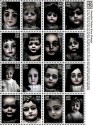
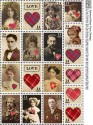
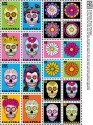
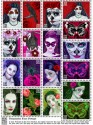
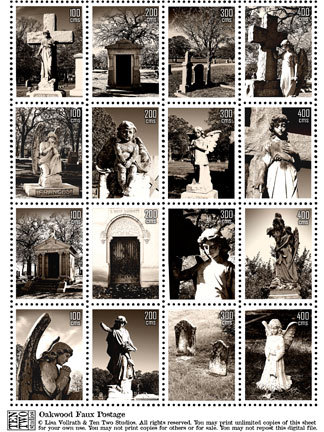
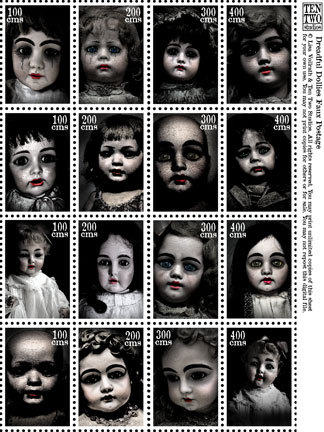
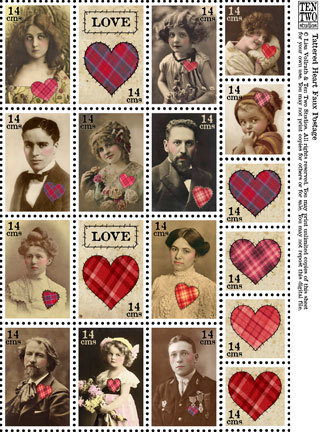
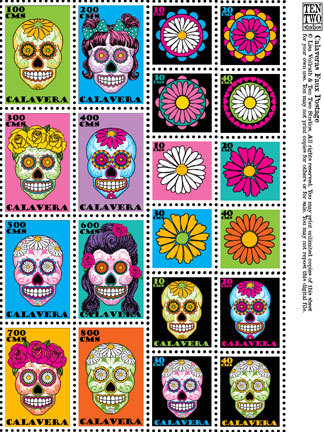
Faux postage stamps are created in a variety of ways, but the most popular method to create them is using a computer for design and layout, and then either printing on paper that is pre-perforated, or perforating the printed sheets afterward. Stamps can be created in sheets or individually, or even to mimic the commemorative issues put out by the Post Office.
I am an avid maker of faux postage stamps. Some of my designs, including those below, are available for purchase at Ten Two Studios.
Decorated Envelopes
The tradition of sending decorated envelopes has long been practiced by mail artists. The envelopes themselves have evolved into their own form of mail art, often sent through the mail with little or nothing in them. Integrating the sender and recipient addresses, and the postage required to send the envelope, is often an integral part of the envelope’s design.
One of the longest running decorated envelope project is The Graceful Envelope, sponsored by the Washington Calligraphers Guild. Each year since 1995, artists have decorated envelopes according to the annual theme. The best envelopes selected in several categories are put on display in Washington, DC.

Naked Mail
Sometimes known as extreme mail art, naked mail is the sending of odd items through the mail without any packaging. In my years as a mail artist, I’ve received beach balls, flip-flops, a plastic severed hand, a giant plastic crayon bank, a large pink piggy bank, baby bottles, and liter and two-liter bottles filled with all manner of items.
One of the objects of naked mail is to surprise postal employees. Taking the items to the post office window to be weighed and have postage attached, and receiving the naked mail items from your regular postal carrier are part of the naked mail experience.
One of my favorite types of naked mail is the plastic bottle mailgram. A clear plastic bottle is filled with items the recipient might enjoy, and mailed without packaging. Instructions for making plastic bottle mailgrams that fill easily, and will pass through most US post offices are posted here at Go Make Something.

Artist Trading Cards
Artist trading cards, or ATCs, are small-format artworks exchanged between artists. Unlike other types of mail art, artist trading cards do have a few rules. They must be created on a 2-1/2″ x 3-1/2″ surface, and must fit into a trading card sleeve, which is a clear pocket designed to hold baseball trading cards.
Although artist trading cards originated as a way for artists to meet face-to-face to exchange work, with the rise of the Internet came endless numbers of groups where artists can exchange cards by mail. One of the largest groups online focused on exchanging artist trading cards is ATCsForAll, where you’ll find dozens of open swaps at any given time, and thousands of people willing to do a one-on-one exchange.

Trashpo
Trashpo is short for trash poetry, a concept that originated with visual poet Jim Leftwich. In 2005, Leftwich dumped a wastebasket onto a scanner, and posted photos of the random poetry this created. Trashpo is a form of visual poetry, based on random, found arrangements of letters, words, and images. In its very broadest sense, trashpo is art made from garbage.
The trashpo community has its own words to describe the types of work this concept has spawned, and they are as unique as the artists who create them. For example:
Cerealism is trashpo made from cereal boxes.
Listpo is list poetry made using found lists, like shopping lists.
Scannerbed composition is a method of creating trashpo by dumping trash on a scanner and scanning it.
IUOMA
The International Union of Mail Artists (IUOMA) was founded in 1988 by Dutch artist Ruud Janssen. IUOMA has been the center of the online mail art universe for many years, moving from site to site, but keeping many of the same core members and ideals. There are currently over 3,500 members online, and the web site is one of the largest repositories of mail art calls and images of mail art. New members are welcomed heartily, and there is no charge to join or participate in the many projects going at any given time.
Mail Art on the Internet
Examples of various types of mail art are abundant online, but seem to move around and disappear quickly. This collection of sites represents the links I was able to capture the last time this page was updated:
Mail Me Art is a mail art documentation project. Viewers send mail art, and the recipient blogs what has been received. The project has spawned several exhibitions.
The Mail Art Pool on Flickr has gone silent in recent years, but people are still adding their photos to the pool.
The Electronic Museum of Mail Art has several galleries of mail art, including a small collection of artistamps by various artists.
Com`post Mail Art displays the work of German artists who have participated in mail art projects for over 20 year. There isn’t much text to describe the collections, but there are lots of photos.
1000 Journals was an art journal project that happened by mail. The project’s originator sent out 1000 blank journals, and they were passed around using an online queue system. The project is finished, but the photos of journals remain posted.
Mail Art Projects is a blog maintained by 100 members of IUOMA. It posts mail art calls from all over the world.
What is Mail Art?
March 28, 2006
The Art is in the Mail
The simplest definition of mail art is that it is any art that’s created with the intention of sending it through the mail. Mail art can include postcards, faux postage, decorated envelopes, friendship books, and the ever popular naked mail. If you have to mail it to complete the creative experience, it’s mail art!
Mail Art Culture
When it comes to the making of mail art, there are very few rules. However, most mail art projects have these similarities:
No money exchanges hands. In general, mail art is exchanged between artists, not bought and sold. There aren’t usually fees involved to participate in mail art projects.
Mail art is given freely, without the expectation of something in return.
No judgements are made about the artwork or its quality. You get what you get.
Once the envelope has been dropped into the mail, forget about it.
Postcards
Postcards are probably the most popular form of mail art. Handmade, altered, or trash postcards are often exchanged between mail artists, either one on one, or in organized swaps or exchanges. Perhaps postcards are so popular because they are already a type of mail, and are so easily sent, without packaging, and with minimal postage.
Postcards are often used in mail art exhibitions, with are organized through mail art calls. The project organizer puts together a theme and a venue for display, and posts the call to creative groups focused on mail art. Interested artists mail in a postcard, to be included in the exhibition. Sometimes, they receive another postcard in return, or a visual listing of the pieces in the exhibition, known as documentation.
One of the most well-known postcard projects is Post Secret. Since 2005, the project organizer has asked readers to mail him an anonymous postcard with a secret written on it, to be posted on the Post Secret blog. Hundreds of postcards have been sent in and posted, and the project has spawned several books.
Postcrossing is a site designed for those interested in sending and receiving postcards. Rather than matching senders and receivers, the site is set up so that your postcard is assigned a number, and when your card is received and logged by the recipient, your name is put into the queue to receive the next postcard sent.
Artistamps
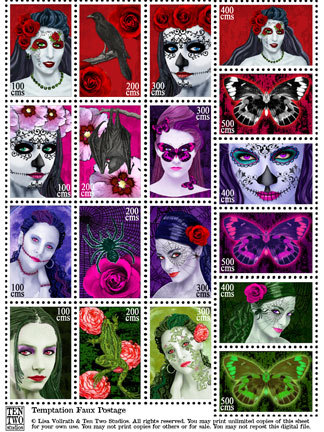
Artistamps go by several different names: faux postage, postoids, or cinderellas. These terms are used to describe an artist-created stamp that is not used as real postage. In fact, one of the rules of using artistamps is that they must not be substituted for real postage, or used in any way that attempts to defraud the Post Office.Faux postage stamps are created in a variety of ways, but the most popular method to create them is using a computer for design and layout, and then either printing on paper that is pre-perforated, or perforating the printed sheets afterward. Stamps can be created in sheets or individually, or even to mimic the commemorative issues put out by the Post Office.
I am an avid maker of faux postage stamps. Some of my designs, including those below, are available for purchase at Ten Two Studios.
Decorated Envelopes
The tradition of sending decorated envelopes has long been practiced by mail artists. The envelopes themselves have evolved into their own form of mail art, often sent through the mail with little or nothing in them. Integrating the sender and recipient addresses, and the postage required to send the envelope, is often an integral part of the envelope’s design.
One of the longest running decorated envelope project is The Graceful Envelope, sponsored by the Washington Calligraphers Guild. Each year since 1995, artists have decorated envelopes according to the annual theme. The best envelopes selected in several categories are put on display in Washington, DC.
Naked Mail
Sometimes known as extreme mail art, naked mail is the sending of odd items through the mail without any packaging. In my years as a mail artist, I’ve received beach balls, flip-flops, a plastic severed hand, a giant plastic crayon bank, a large pink piggy bank, baby bottles, and liter and two-liter bottles filled with all manner of items.
One of the objects of naked mail is to surprise postal employees. Taking the items to the post office window to be weighed and have postage attached, and receiving the naked mail items from your regular postal carrier are part of the naked mail experience.
One of my favorite types of naked mail is the plastic bottle mailgram. A clear plastic bottle is filled with items the recipient might enjoy, and mailed without packaging. Instructions for making plastic bottle mailgrams that fill easily, and will pass through most US post offices are posted here at Go Make Something.
Artist Trading Cards
Artist trading cards, or ATCs, are small-format artworks exchanged between artists. Unlike other types of mail art, artist trading cards do have a few rules. They must be created on a 2-1/2″ x 3-1/2″ surface, and must fit into a trading card sleeve, which is a clear pocket designed to hold baseball trading cards.
Although artist trading cards originated as a way for artists to meet face-to-face to exchange work, with the rise of the Internet came endless numbers of groups where artists can exchange cards by mail. One of the largest groups online focused on exchanging artist trading cards is ATCsForAll, where you’ll find dozens of open swaps at any given time, and thousands of people willing to do a one-on-one exchange.
Trashpo
Trashpo is short for trash poetry, a concept that originated with visual poet Jim Leftwich. In 2005, Leftwich dumped a wastebasket onto a scanner, and posted photos of the random poetry this created. Trashpo is a form of visual poetry, based on random, found arrangements of letters, words, and images. In its very broadest sense, trashpo is art made from garbage.
The trashpo community has its own words to describe the types of work this concept has spawned, and they are as unique as the artists who create them. For example:
Cerealism is trashpo made from cereal boxes.
Listpo is list poetry made using found lists, like shopping lists.
Scannerbed composition is a method of creating trashpo by dumping trash on a scanner and scanning it.
IUOMA
The International Union of Mail Artists (IUOMA) was founded in 1988 by Dutch artist Ruud Janssen. IUOMA has been the center of the online mail art universe for many years, moving from site to site, but keeping many of the same core members and ideals. There are currently over 3,500 members online, and the web site is one of the largest repositories of mail art calls and images of mail art. New members are welcomed heartily, and there is no charge to join or participate in the many projects going at any given time.
Mail Art on the Internet
Examples of various types of mail art are abundant online, but seem to move around and disappear quickly. This collection of sites represents the links I was able to capture the last time this page was updated:
Mail Me Art is a mail art documentation project. Viewers send mail art, and the recipient blogs what has been received. The project has spawned several exhibitions.
The Mail Art Pool on Flickr has gone silent in recent years, but people are still adding their photos to the pool.
The Electronic Museum of Mail Art has several galleries of mail art, including a small collection of artistamps by various artists.
Com`post Mail Art displays the work of German artists who have participated in mail art projects for over 20 year. There isn’t much text to describe the collections, but there are lots of photos.
1000 Journals was an art journal project that happened by mail. The project’s originator sent out 1000 blank journals, and they were passed around using an online queue system. The project is finished, but the photos of journals remain posted.
Mail Art Projects is a blog maintained by 100 members of IUOMA. It posts mail art calls from all over the world.
Subscribe to:
Posts (Atom)